
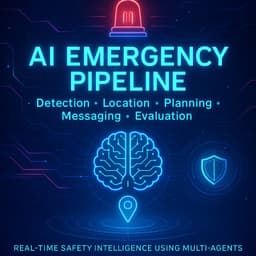
Hello everyone, my name is Smita Chaudhari, and today I am presenting my project titled AI-Powered Emergency Response Agent. This system is designed to automatically detect danger and generate real-time emergency alerts using a multi-agent architecture. Emergencies happen fast. In situations like harassment, stalking, accidents, or sudden medical distress, people often panic. They freeze. They don’t get time to explain what’s happening. A simple message like “someone is following me” may be all they can manage. But behind such short messages, there is missing information — the type of danger, its severity, the exact location, who should respond first, and what action should be taken. My project solves this problem. This system uses a team of specialized AI agents that work together to understand the emergency, identify where it is happening, create a rescue plan, generate SOS messages, and finally evaluate the entire pipeline for safety and clarity. It reacts instantly, ensuring help is on the way even when the user is unable to manually describe the situation. Let’s begin with why this problem matters. Fear limits help-seeking. People in distress often hesitate to communicate clearly. Manual input during emergencies is inefficient and slow, and every second counts. There is a strong need for a system that can automatically sense danger and trigger alerts without requiring any additional user action. That is exactly what my multi-agent pipeline provides. Next, let’s understand why we use agents. Emergencies require specialized responses. A single large language model cannot handle all tasks effectively. Multi-agent systems allow modular, specialized decision-making. Each agent has one job, which increases clarity, reliability, and response speed. This structure also ensures that the final output is organized and safe. Now let’s explore the architecture. The pipeline contains five agents: The Detection Agent identifies the type and severity of the emergency based on the user's text. Whether it's harassment, injury, theft, or medical distress, this agent interprets the situation from only a few words. The Location Agent determines the nearest police stations and nearby civilian helpers using simulated GPS data. It calculates real distances using the Haversine formula and fetches the closest support resources. The Planner Agent then constructs a complete rescue plan tailored to the emergency. It decides who should be alerted first — police, civilians, or personal contacts — and generates a step-by-step action sequence. Next, the Message Agent converts the plan into clear, structured SOS alerts. It writes individual messages for the police, nearby helpers, and the user’s emergency contacts. Everything is generated automatically and instantly. Finally, the Judge Agent verifies the entire pipeline. It checks the safety, clarity, and urgency of the generated responses and ensures that no unsafe or unclear actions are included. All these agents work together inside a coordinated multi-agent flow managed by an end-to-end orchestrator. For building this project, I used several tools and techniques: Python for development, Google ADK for agent building, a multi-agent pipeline architecture, Haversine distance calculation for location accuracy, rule-based detection for understanding emergencies, GPS simulation, and thorough sample text testing inside a Kaggle Notebook environment. Now, let’s look at an example. When the user types: “Someone is following me near the gate” — the system immediately identifies a harassment case with medium severity, finds the nearest police unit, locates civilian helpers, creates a rescue plan, generates emergency messages, and evaluates the response. Everything happens in one automated flow, within seconds. In conclusion, this project demonstrates how multi-agent AI can support real-time safety. By combining detection, location intelligence, planning, communication, and evaluation, the system provides fast, structured, and reliable emergency response. It transforms simple human input into a complete rescue strategy. Thank you for listening, and I hope you found this project insightful