
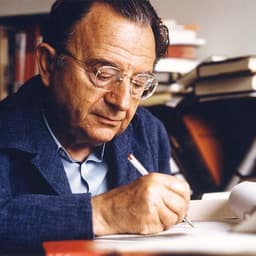
I was born on March 23, 1900, in Frankfurt, Germany, the only child of deeply religious Orthodox Jewish parents. My childhood was filled with both faith and conflict. My father was a moody man, and my mother often suffered from depression. I loved them, but I grew up feeling torn between two worlds — the traditional Jewish life at home and the modern capitalist world outside. That tension shaped how I learned to see life from more than one side. As a boy, I studied the Old Testament with remarkable rabbis—humanists who believed in compassion, peace, and justice. Their teachings stayed with me and became the roots of my later humanistic philosophy. But my peace was shattered when I was still very young. A beautiful young woman, full of life and art, took her own life so she could be buried beside her father. I could not understand how someone could prefer death to the beauty of living. That question haunted me for years and led me toward Freud and psychoanalysis. Then came the First World War. I was only fourteen, too young to fight, but not too young to witness how an entire nation could lose its reason. I saw ordinary people—kind, intelligent people—become consumed by hatred, nationalism, and blind obedience. I asked myself endlessly, How can human beings become so irrational, so destructive? That question became the center of my life’s work. After the war, I studied psychology, philosophy, and sociology, searching for answers about both the individual and society. I admired Freud and Marx, but I also saw their limits. I wanted to understand not only the mind or the economy—but the whole human being. My studies in psychoanalysis in Berlin were intense. Though I never met Freud, I learned much from his followers. In 1934, as the Nazis rose to power, I left Germany and moved to the United States. There, in New York, I began to form my own ideas—ones that combined psychology, social theory, and a deep concern for freedom and love. In 1941, I published Escape from Freedom, my attempt to answer why people fear freedom and often submit to authority. Later, in The Art of Loving, I wrote about love as something that must be learned and practiced—not just felt. When my wife and I moved to Mexico, I found peace in teaching and writing. The warmth of the people and the beauty of the land helped me continue my work. I also explored Zen Buddhism and learned from its calm rationality and spiritual depth. Now, looking back on my life, I see that everything—from my strict Jewish upbringing, the tragedy of that young woman, the madness of war, to my lifelong search for love and understanding—was all part of one great question: What does it mean to be truly human?