
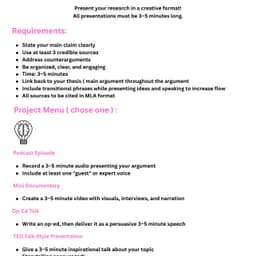
Speech Title: Should AI Play a Central Role in Diagnosing Medical Conditions? Hello everyone, and thank you for being here. Today, I want to talk about a question that could redefine the future of healthcare: Should artificial intelligence play a central role in diagnosing medical conditions? The short answer? Yes—but with caution. The healthcare system faces enormous challenges—long wait times, overloaded hospitals, human error, and rising costs. Now imagine a tool that can analyze massive amounts of patient data in seconds, identify subtle patterns that doctors might miss, and suggest accurate diagnoses faster than ever before. That tool already exists. It’s AI. Supporters of AI in medicine argue that it can make healthcare faster, cheaper, and more precise. And research backs that up. In a study by Rossi and colleagues, AI proved to be not only cost-effective but also clinically competitive. For example, in dermatology cases, AI diagnostic systems reduced average costs while delivering similar, or even better, health outcomes compared to traditional methods. But the benefits don’t stop there. AI also brings speed and accuracy to the table. According to researchers Khalifa Mohamed and Mona Albadawy, AI can cut diagnosis time from days to just minutes—and improve accuracy by up to 20%. Think about what that means in emergency situations. Faster answers mean faster treatment, and that can save lives. Still, let’s be honest—AI isn’t perfect. There are valid concerns, especially around trust and ethics. Some doctors are hesitant to rely on machines. And rightly so. As Wang and Wang point out, AI tools still struggle to earn full confidence from medical professionals. Plus, we need to talk about bias. Algorithms are only as fair as the data they’re trained on, and if we’re not careful, these systems could unintentionally reinforce existing inequalities. So what’s the solution? Balance. AI should never replace the human touch in medicine. It should support doctors, not substitute them. We need systems that are transparent, rigorously tested, and ethically sound. And we need to ensure that empathy, intuition, and human judgment remain at the heart of patient care. In conclusion, AI has the power to revolutionize medical diagnostics—but only if we apply it wisely. By combining the strengths of technology with the compassion of human caregivers, we can build a future where healthcare is not only smarter, but also more humane. Thank you.