Best Text to Speech APIs for Developers: A Technical Comparison

Integrating voice into an app sounds simple until you're three sprints in, debugging audio artifacts at 2 a.m., and discovering that the "free tier" you chose is limited to 500 requests per day. According to a developer survey in 2024, 64% of teams rank cost as their top priority when choosing a speech API, followed by performance at 58% and accuracy at 47%. The difference between a TTS API that performs well in a demo and one that remains reliable in production is much larger than most README files imply.
This guide explains what actually matters when evaluating text to speech APIs for integration, outlines the leading options available in the market, and highlights the tradeoffs that often emerge only after you've committed your codebase to a specific vendor.
What to Look for in a TTS API
Before comparing specific providers, it would be helpful to define what "good" means for a developer use case. Voice count and language coverage are frequently emphasized in marketing contents, which, however, rarely indicate whether an API will hold up in real-world use cases.
The factors below typically distinguish production-ready TTS APIs from those that perform well only in demos:
| Criteria | Why It Matters | What to Test |
|---|---|---|
| Latency | Real-time apps (voice agents, IVR) require sub-500 ms response times | Measure time-to-first-byte on a 100-word input |
| Streaming support | Avoid waiting for the generation of the entire audio file | Verify whether the API supports chunked audio delivery |
| Voice quality | Directly affects user trust and engagement | Evaluate samples longer than 30 seconds, not just 5-second demos |
| Language coverage | Multilingual products require consistent quality across languages | Test non-English output with native speakers |
| Pricing model | Per-character, per-request or per-minute pricing changes your cost structure | Model expected usage volume, and then multiply by three |
| SDK quality | Poor SDKs lead to more wrapper code and longer-term maintenance | Verify async support, type hints, and error handling |
| Voice cloning | Used to customize brand voices or user-generated voice options | Review the minimum sample length, audio fidelity, and turnaround time |
Latency and streaming support deserve particular attention. If you're building a conversational AI agent or a real-time assistant, a three-second delay in audio generation will significantly degrade the experience. APIs designed primarily for batch narration often underperform in these use cases.
Top TTS APIs for Developers
Fish Audio API
Fish Audio offers a developer-focused TTS platform that includes a RESTful API, an official Python SDK with async support, and pay-as-you-go pricing with no subscription minimums.
In terms of integration, the key API technical specs include sub-500 ms latency with real-time streaming, coverage of 30+ languages with strong cross-language performance (particularly useful when scripts mix English with Chinese, Japanese, or Korean terms), and access to a community voice library with more than 2,000,000 voices.
For developers in need of voice cloning, Fish Audio's cloning feature requires only a 15-second audio sample to generate a high-fidelity replica. This is a lower barrier than most competitors, which typically require 1 to 5 minutes of clean audio.
The API documentation is organized around practical integration patterns rather than feature lists. The SDK provides streaming support and comprehensive type hints, reducing friction in the implementation process. Pricing is $15 per million UTF-8 bytes (approximately 180,000 English words or about 12 hours of speech), with no hidden fees.
From a technical perspective, one notable advantage is the open-source Fish Speech model (Apache 2.0), which allows for self-hosting when data residency or latency requirements make it necessary. This flexibility is seldom offered by common commercial TTS providers.
Best for: developers building multilingual apps, voice agents, game dialogue systems, or any product where low latency and voice cloning are critical requirements.
Google Cloud Text to Speech
Google Cloud TTS is often the default choice for enterprise teams already operating on GCP. It offers 380+ voices across 50+ languages, powered by DeepMind's WaveNet and Neural2 models. In addition to the extensive SSML support, Google Cloud TTS also integrates seamlessly with other Google Cloud services (e.g., Speech-to-Text, Translation API).
The free tier provides 1 million characters per month for standard voices and an additional 1 million for WaveNet voices, which is generous for prototyping. Standard voice pricing starts at $4 per million characters.
The tradeoff is limited voice customization compared to platforms with cloning capabilities. Those in need of a specific brand voice or user-generated voices may reach functional limits. Moreover, the latency is also higher than some specialized providers, making it less suitable for real-time conversational use cases.
Best for: enterprise teams operating on GCP that require broad language coverage and large-scale reliability.
Amazon Polly
Polly integrates seamlessly with AWS-native stacks. It offers Neural TTS voices across 40+ languages, specific newscaster-style English and Spanish voice options, and a per-character pricing model starting at 16 for neural voices.
The differentiated feature is automatic duration control, which adjusts speech rate to match a target duration. This is particularly useful for dubbing or synchronizing audio with video timelines. Custom voice options are available but require contacting AWS sales, indicating enterprise-level pricing.
One limitation is that the voice library appears to be somewhat outdated compared to newer AI-native providers. While the neutral voices are reliable, they do not match the quality of platforms built primarily around voice performance.
Best for: AWS-native teams that need reliable and scalable TTS within their existing infrastructure.
ElevenLabs
ElevenLabs focuses on ultra-realistic voice quality, particularly for English narration. In addition to a strong voice cloning capability,the platform supports 70+ languages. The API is well-documented, with SDKs available for Python, JavaScript, and other languages.
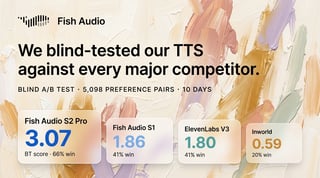
The pricing model is subscription-based, starting at approximately $5 per month for limited character usage and the costs rise quickly as usage increases. Hence, at scale, costs can escalate faster than pay-as-you-go alternatives. Independent comparisons suggest that Fish Audio delivers comparable quality at roughly 70% lower cost for equivalent usage volume.
Best for: creative projects with flexible budgets, where English voice quality is the top priority.
OpenAI TTS
OpenAI's TTS API is relatively new, but it benefits from the seamless integration with the GPT ecosystem. For those already using the OpenAI API for chat completions, enabling voice output requires minimal additional setup.
There are limited voice options (six built-in voices at launch), and the customized options are modest compared to specialized TTS platforms. It does not support voice cloning or SSML, and the language tuning capabilities are restricted.
Best for: Projects built within the OpenAI ecosystem where the ease of integration and the speed of implementation matter more than voice variety.
Microsoft Azure TTS
Azure's neural TTS engine offers 400+ voices across 140+ languages, providing the most extensive language coverage in the industry. With the Custom Neural Voice,enterprises can create customized voices, though the process requires significant audio data and time.
Pricing is competitive at $15 per million characters for neural voices, and the free tier includes 500,000 characters monthly. Azure offers the most refined SSML support available, allowing precise control over pitch, speaking rate, and emphasis.
Best for: enterprises that require the broadest language and dialect coverage along with advanced customization capabilities.
Quick Comparison Table
| API | Languages | Voice Library | Latency | Voice Cloning | Pricing Model | Open Source |
|---|---|---|---|---|---|---|
| Fish Audio | 30+ | 2,000,000+ | Sub-500 ms streaming | Yes (15s sample) | Pay-as-you-go | Yes (Apache 2.0) |
| Google Cloud TTS | 50+ | 380+ | Moderate | No | Per-character | No |
| Amazon Polly | 40+ | 60+ | Moderate | Limited (enterprise only) | Per-character | No |
| ElevenLabs | 70+ | Expanding | Low | Yes (1-5 min sample) | Subscription | No |
| OpenAI TTS | 50+ | 6 | Low | No | Per-character | No |
| Azure TTS | 140+ | 400+ | Moderate | Yes (enterprise) | Per-character | No |
How to Evaluate a TTS API Before Committing
Reading relevant docs and comparing feature matrices only provides limited insight. The following practical testing framework helps uncover real-world issues before they turn into production problems.
Step 1: Test with your actual content. Don't rely on the provider's demo sentences. Send a representative sample of your production text through the API, including edge cases like abbreviations, mixed-language phrases, numbers, and technical terminology.
Step 2: Measure latency under load. Single-request latency benchmarks can be misleading. Simulate your expected concurrent request volume and measure p95 latency. An API that performs well at 10 requests per second may degrade significantly at 100.
Step 3: Evaluate the SDK, not just the API. A clean REST API does not make up for a poorly maintained SDK. Verify whether it provides async support, well-defined error types, retry logic, and streaming capabilities. Fish Audio's Python SDK, for example, includes async support and comprehensive type hints out of the box.
Step 4: Calculate actual costs. Align your expected usage patterns with each provider's pricing model. Pay-as-you-go models like Fish Audio's generally suit variable workloads, while subscription tiers may be more cost-effective for predictable and high-volume usage.
Common Integration Patterns
Most TTS API integrations fall into one of the following three patterns, each with distinct technical requirements.
Batch generation is the simplest. You just need to submit text, receive audio files, and store them for playback. Latency is less critical in this pattern. Voice quality and cost per character are the primary decision factors. Audiobook production, pre-recorded IVR prompts, and video voiceovers typically follow this pattern.
Real-time streaming is where API choice becomes critical. Voice agents, live assistants, and interactive applications require the API to begin returning audio chunks before the entire text is processed; however, not all APIs handle this effectively. Fish Audio's streaming API and Cartesia are specifically optimized for this pattern.
Hybrid workflows combine both of the above patterns. A content platform might use batch generation through Fish Audio's Story Studio for published audiobooks, while relying on the streaming API for real-time preview during editing.
Frequently Asked Questions
What's the most cost-effective TTS API for high-volume developer use?
For high-volume and variable workloads, pay-as-you-go pricing models generally offer the most flexibility. Fish Audio's API charges $15 per million UTF-8 bytes, with no subscription minimums or hidden fees, roughly equivalent to 12 hours of speech output. At similar usage volumes, this typically costs 50-70% less than subscription-based alternatives. Google Cloud TTS and Amazon Polly are also competitive for batch workloads, although they do not offer voice cloning or community voice library features.
Which TTS API has the lowest latency for real-time voice agents?
For conversational AI and voice agent applications, you'll need streaming support with sub-500 ms time-to-first-byte. Fish Audio and Cartesia are both optimized for this use case. Fish Audio's streaming API delivers audio chunks in real time, and its emotion control tags allow you to add tone variations (helpful, empathetic, upbeat) to agent responses without post-processing.
Can I clone a custom brand voice through a TTS API?
Yes, but requirements vary significantly by providers. Fish Audio's voice cloning requires only a 15-second audio sample to generate a high-fidelity voice replica that works across 30+ languages. ElevenLabs requires 1 to 5 minutes of clean audio. Azure's Custom Neural Voice requires substantially more data and a formal onboarding process. Google Cloud TTS and OpenAI TTS do not support voice cloning through their standard APIs at present.
Is there a free TTS API I can use for prototyping?
Most providers offer free tiers. For instance, Fish Audio provides a free plan with playground access for testing voice quality and API functionality before committing to paid usage. Google Cloud TTS offers 1 million free characters per month. Amazon Polly offers 5 million free characters for the first 12 months. These free tiers are generally sufficient for prototyping and early development.
Which TTS API supports the most languages?
Supporting over 140 languages and dialects, Microsoft Azure TTS leads in total language count. Google Cloud TTS supports 50+ languages. For practical multilingual support, however, language count alone isn't the deciding factor. Fish Audio supports 30+ languages but stands out for cross-language quality, particularly when scripts mix terms from multiple languages (a common scenario in global products). The platform handles mixed English-Chinese, English-Japanese, and other language combinations with minimal pronunciation errors, which significantly reduces post-production cleanup.
Do I need an open-source TTS model, or is a hosted API enough?
It depends on your data residency and latency requirements. If audio generation must remain on-premises or within a specific region, an open-source model may be necessary. Fish Audio's Fish Speech model is licensed under Apache 2.0 and supports local deployment, allowing you to self-host while continuing to use the hosted API for development and testing. Most teams start with a hosted API and transition to self-hosting only when compliance or performance requirements make it necessary.
Conclusion
Your choice of TTS API will depend on your specific technical requirements, not on which provider has the longest feature list. For most developer teams building modern voice-enabled applications, the evaluation comes down to four factors: latency performance, voice quality in your target languages, pricing at your expected usage volume, and SDK quality.
If you're building real-time voice features, multilingual products, or applications that require voice cloning, Fish Audio's API is worth evaluating first. The combination of low-latency streaming, a large-scale community voice library, competitive pay-as-you-go pricing, and open-source deployment options supports a broad range of developer use cases. Start with the free tier, test using your actual production content, and benchmark against alternatives before making a final decision.

Kyle is a Founding Engineer at Fish Audio and UC Berkeley Computer Scientist and Physicist. He builds scalable voice systems and grew Fish into the #1 global AI text-to-speech platform. Outside of startups, he has climbed 1345 trees so far around the Bay Area. Find his irresistibly clouty thoughts on X at @kile_sway.
Read more from Kyle Cui