Manu
por Sherry BalouchIt was back in the spring of 1885 when the sun rose slow over the wide plains of Montana, turning the dry grass into a sea of gold. The mornings were quiet out there, except for the sound of the wind rubbing against the barn doors and the cry of a hawk overhead. Folks around those parts lived simple, and they kept to themselves. But every small town’s got a story that lives a little longer than the people who tell it, and this one’s about a man named Caleb Rourke.
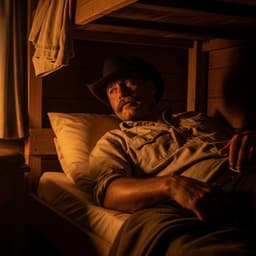
Caleb was a big man, tall and steady, with hair gone gray too early and eyes the color of worn denim. He wasn’t the kind who talked much, but folks said you could read his whole life just by lookin’ into those eyes. He’d been a rancher all his years — strong with the rope, gentle with the cattle, and respected by every soul in Pine Ridge County. But behind that weathered face was a heart that carried more weight than a man ought to bear.
A year before our story begins, Caleb had buried his wife, Eliza, just a week after she gave birth to their first child, a boy named Benji. Folks said he stood by her grave three nights straight, never spoke a word, never cried in front of anyone. Only the preacher saw him one morning, sittin’ beside that fresh mound of earth, rockin’ the newborn in his arms and hummin’ a tune so soft it could make a hawk land quiet. From that day on, Caleb lived for the boy — nothing more, nothing less.
His ranch was three miles west of town, a modest place with fences that leaned and a porch that creaked when the wind hit right. Every dawn, he’d feed the horses, check the cattle, then cradle Benji in one arm while fixing the fire with the other. Town folks sometimes offered help, but Caleb politely turned them down. Pride runs deep in men like him. He said the ranch would be raised by his own hands, and the boy would grow up the same way.
Now, Pine Ridge was a town that noticed things — and people had started noticing a young woman who came by Caleb’s place now and then. Her name was Clara Mayfield, twenty-four years old, daughter of the man who ran the general store. She was quiet but kind, always bringing fresh milk or a basket of vegetables. Said she did it out of neighborly duty, but everyone knew she lingered longer than she needed to. Caleb, being the man he was, thanked her each time, polite and distant. But what he didn’t say was that her visits had become the one light spot in his long, lonesome days.
Clara had first seen Caleb at church, holding little Benji close, standing near the back like a man unsure if he still belonged among the living. Something in his eyes caught her — maybe it was the strength, maybe it was the sorrow. Every Sunday after that, she’d find a reason to walk by his pew, to smile at the baby, to exchange a word or two.
Weeks turned to months. Summer rolled in, hot and dusty, the kind that cracked the ground and burned the sky pale. One evening, Caleb was fixing a broken fence when Clara rode up, dress fluttering, face flushed from the heat. She had a jar of honey and a loaf of bread in her hands.
“You work too hard,” she said softly, stepping down from her horse.
Caleb gave her a tired smile. “Hard work’s the only thing that keeps a man upright.”
She looked at the baby’s cradle on the porch, swaying in the breeze. “And love,” she added. “Love keeps a man upright too.”
He didn’t answer. He just looked out toward the hills, where the sun was bleeding red into the horizon. For a long moment, neither of them spoke. Then she placed the honey jar on the porch rail and said, almost in a whisper, “You don’t have to carry everything alone, Mr. Rourke.”
That night, when the baby was asleep and the fire low, Caleb sat by the window with his hat in his hands. He thought about what she’d said. Maybe she was right — but how does a man open a heart that’s been shut tight by loss?
A week later, a summer storm swept through Pine Ridge — heavy rain, thunder that shook the barn walls. Lightning struck near the east pasture, and Caleb had to rush out in the dark to guide the herd back. He slipped, hit his shoulder, and by the time he made it back, soaked and half-hurt, the baby was crying in the crib.
Through that downpour, Clara came running from her house two miles away, drenched but determined. She found Caleb struggling to change the child’s blanket with one arm. Without asking, she took the baby gently from him and wrapped Benji in her shawl.
Caleb tried to speak, but the words just didn’t come. He stood there, rain dripping from his hat, watching her hum softly to his son — the same tune he used to hum to Eliza. It made something deep inside him ache, like an old wound remembering what it was to heal.
That night, for the first time in a long while, he let someone stay. Clara sat by the fire, drying her hair, rocking Benji in her arms. Caleb poured her a cup of coffee, his hands trembling slightly. They didn’t talk much — they didn’t have to. Sometimes silence between two people says more than words ever could.
By morning, the storm had passed, and the air smelled like wet earth and new beginnings. Caleb walked her to the fence, thanked her for what she did. She smiled, brushing a strand of hair from her face. “Any time,” she said softly. “You and Benji ain’t alone in this world, Caleb. Not anymore.”
He watched her ride away, the sunlight breaking through the clouds behind her. And in that quiet, something shifted inside him — a weight lifted just a little, like the earth itself had taken a breath.
That’s how the change began.As the days rolled on after that storm, life in Pine Ridge carried its steady rhythm again. The ranchers rose before dawn, the saloon opened by noon, and the town’s heart beat slow and even, the way it always had. But for Caleb Rourke, something small had changed — something soft, almost unnoticed.
He’d catch himself waiting by the porch come evening, listening for hoofbeats down the road. And sure enough, more often than not, Clara would come riding by with that quiet smile of hers and a basket in her hand. Sometimes it was fresh bread, sometimes it was nothing but a few apples from her father’s orchard. But she always stayed long enough to see the baby and ask how the day had gone.
At first, folks thought nothing of it. Pine Ridge was the kind of place where people looked after one another. But after a while, tongues started wagging. Old women by the post office, young cowhands at the saloon — they all had their own stories about the widow’s man and the storekeeper’s daughter. Some said it wasn’t proper, some said she was foolish. Others, kinder ones, said maybe that lonely cowboy deserved a bit of light again.
Caleb heard whispers when he came into town for supplies. He’d nod at the men, thank the shopkeeper, and walk out before the talk got too thick. But inside, he felt a mix of shame and something he couldn’t quite name — something that felt a lot like hope.
One late afternoon, Clara came by as usual. Benji was crawling in the grass by then, giggling in the dirt while the sun went down over the hills. Clara knelt beside him, laughing softly when he grabbed her finger. Caleb stood by the fence, arms folded, just watching.
“You’re good with him,” he said quietly.
She looked up, eyes warm. “Children know when someone’s heart’s gentle. They trust it.”
He smiled faintly. “You talk like you know me.”
“I reckon I do,” she said. “You think you hide your heart, Caleb, but you don’t. It shows every time you look at that boy.”
He turned away, staring toward the horizon. “Ain’t easy, Clara. Losing someone like Eliza — it changes a man. Makes him scared to care again.”
She stood, brushing the dust off her dress. “Then don’t call it caring. Call it living. You still got a heart beating, and it ain’t meant to go quiet forever.”
That night, when the sky was clear and full of stars, Caleb took Benji outside and sat on the porch steps. He rocked the boy gently, looking up at the same stars Eliza used to watch. For the first time, he spoke out loud, his voice low and cracked.
“Eliza,” he said, “I don’t know if you can hear me up there. But there’s someone who’s been kind to our boy — and to me. I don’t know what to do with it. I don’t wanna lose you, but I don’t wanna live half a life neither.”
A light wind passed over the fields, stirring the grass. He took it as his answer.
The next week, Clara invited Caleb and Benji to a church picnic by the river. He hadn’t been to a gathering since the funeral. He almost said no, but when Benji tugged at his sleeve, smiling, he couldn’t refuse.
The day was bright and full of laughter. Children splashed by the water, women laid out pies, and the preacher strummed a banjo. Caleb stood a little apart, hat low, trying to blend with the shade of an old oak. Clara came over, her dress a soft sky blue that moved with the breeze.
“Don’t you hide in the shadows all day,” she teased gently. “Come on, Caleb, dance a little. The world won’t break if you smile.”
He chuckled under his breath. “Ain’t danced in years.”
“Then it’s about time,” she said, taking his hand before he could protest.
She led him toward the clearing, where a few couples spun slow to the tune of a fiddle. Caleb moved stiffly at first, like a man unsure of his own body, but Clara laughed, easy and free, guiding him along. Before long, he relaxed, his hand fitting naturally at her waist.
For those few minutes, time lost its grip. The pain, the loss, the whispers — they all faded into the sound of the river and the music and the warmth of a hand that didn’t let go. When the song ended, he stepped back, breathless, eyes softer than they’d been in years.
Later, when he took Benji home, the boy was fast asleep in his arms, the moonlight brushing across his little face. Caleb looked down at him and whispered, “You’d have liked her, son. She’s got a good heart.”
But as with all good things in small towns, word travels faster than the wind. By week’s end, someone had told Clara’s father that she’d been seen dancing with Caleb Rourke, the widowed rancher twice her age.
When she came home that night, her father was waiting by the porch, face hard as oak.
“Clara,” he said, “I’ve heard talk that you’ve been keeping company with that man out on the ridge. You got any sense of what folks are sayin’?”
“I know what they’re sayin’, Pa,” she answered, calm and steady. “And I don’t care. He’s a good man.”
“He’s near old enough to be your father,” the man said sharply. “You’ll bring shame on this family if you don’t stop.”
Her eyes filled but her voice didn’t shake. “He lost everything, Pa. He’s raisin’ that boy on his own. He’s kind, he’s honest, and he’s lonely. If that’s shame, then I’ll bear it.”
Her father turned away, silent, and walked inside. She stood there for a long while, the night cold on her skin, before she whispered, “Some hearts just don’t understand love until it’s too late.”
The next morning, she didn’t go to the store. She rode straight to the Rourke ranch.
Caleb was mending a fence when he saw her coming. She looked tired, eyes red but fierce.
“Clara,” he said softly, “you alright?”
She took a deep breath. “They know, Caleb. Everybody knows. My father said I shouldn’t see you again.”
He swallowed hard. “Then you best listen to him. I ain’t worth the trouble I’ll cause you.”
She stepped closer. “Don’t you dare say that. You’re worth more than you know. You just don’t believe it yet.”
He turned away, jaw tight. “You’re young, Clara. You got a life ahead of you. I’m just an old man with a ranch and a baby.”
She reached out, touched his arm. “You’re more than that. You’re a man who still knows how to love — even if you’re too scared to show it.”
He looked at her, really looked, and for a moment, the world went still.
Then he said, almost in a whisper, “Clara, if I let myself care again, and it all falls apart… I don’t think I could stand to lose one more thing.”
Her hand didn’t move. “Then don’t lose it. Hold it.”
The silence that followed wasn’t heavy this time — it was warm, alive, full of everything they couldn’t yet say.Autumn came early that year. The nights grew cold, and the wind carried the smell of rain and wood smoke across the plains. Clara still came by, though less often. She was torn between duty to her father and the pull of her heart toward the lonely rancher on the ridge.
One afternoon, as she stood in the store helping her father, a letter came from her aunt in Missouri — an offer to move there, start fresh, run a shop of her own. Her father pressed it into her hands and said quietly, “It’s best you take it. There’s nothing for you here but heartache.”
That night, she rode out to see Caleb one last time. The moon was full, silvering the fields. He was sitting on the porch, Benji asleep against his chest. When he saw her, he smiled softly, but there was sadness in his eyes, as if he already knew.
“They want me to leave,” she said, voice breaking. “Missouri. They say it’s a better life.”
He nodded slowly. “Maybe it is. You deserve peace, Clara. You’ve given me more kindness than I ever thought I’d feel again.”
Tears welled in her eyes. “And what about you, Caleb? What about your peace?”
He looked down at the sleeping boy. “He’s my peace.”
She knelt beside him, touching Benji’s small hand. “You both are my heart,” she whispered. “If I go, I’ll carry you with me. Every day.”
He reached out, brushed a tear from her cheek. “You’ve already given me enough, Clara. You reminded me I ain’t dead inside.”
She leaned forward, pressed a soft kiss to his weathered cheek, and said, “Then live, Caleb. Live for him. Live for her memory. And if someday your heart opens again, remember—mine was the first to knock.”
Then she turned, climbed on her horse, and rode away into the silver night.
Caleb watched her until the darkness swallowed her shape. He didn’t call out, didn’t move. Just sat there with Benji in his arms, feeling the ache and the warmth of what love had left behind.
And though she was gone, something deep within him had changed. The next morning, when the sun rose over Pine Ridge, Caleb went to work like always — but this time, he whistled while he did.Years passed in Pine Ridge. The ranch grew strong again, the fences stood straight, and little Benji turned into a boy with his father’s eyes and his mother’s gentle laugh. Folks said Caleb Rourke had changed — still quiet, still steady, but lighter somehow, like a man who’d finally made peace with his ghosts.
He never married again, but every spring, when the wildflowers bloomed near the river, he’d take Benji there with a basket and a jar of honey. They’d sit under the old oak, where once he and Clara had danced, and he’d tell his son about the people who’d shaped his heart.
“She was the kind of soul,” he’d say softly, “who gave more than she ever took. The kind you remember, even when life moves on.”
Benji would listen, wide-eyed, not knowing the weight behind his father’s words.
One morning, years later, a letter came — from Missouri. It was written in neat, careful script. Inside was a short note that simply said, I never stopped praying for you and the boy. I hope the wind still carries my love across the plains.
Caleb folded the letter, placed it in a small wooden box beside Eliza’s ring, and whispered, “It does, Clara. It always does.”
That evening, as the sun sank behind the hills, he stood on his porch, watching Benji chase fireflies in the yard. The world was quiet, soft, and alive again.
And for the first time in a long while, Caleb smiled — a full, easy smile that reached his eyes. The heavy heart had learned to rest, and the gentle soul had found peace.
The prairie wind carried his laughter across the open fields, blending with the sound of the boy’s joy — two souls, one story, still living beneath the same wide Western sky.