AI Audio Translation: The Complete Guide 2026

AI audio translation has become one of the most powerful technologies for global communication. In 2026, businesses, creators, educators, and remote teams rely on AI speech translation to instantly convert spoken language into another language with natural voice output.
From translating podcasts and YouTube videos to enabling multilingual meetings, modern tools now offer speech to speech translation that sounds remarkably human.
This guide explains everything you need to know about AI audio translation, including how it works, the technology behind it, and how to use AI voice translation online tools such as Fish Audio.
What Is AI Audio Translation?
AI audio translation is a technology that converts spoken language into another language automatically. Instead of manually translating transcripts or hiring interpreters, AI systems process speech in three stages:
-
Speech recognition
-
Language translation
-
Speech generation
This creates a speech to speech translation system where users can speak in one language and hear the output in another. Today, many platforms offer AI voice translation online, allowing users to translate audio directly in a browser or through APIs.
How AI Speech Translation Works
Modern AI speech translation relies on several advanced technologies working together.
1. Automatic Speech Recognition (ASR)
ASR converts spoken audio into text.
For example:
Audio input:
"Welcome to today's meeting."
ASR output:
Welcome to today's meeting.
Modern ASR models can understand accents, noisy environments, and conversational speech.
2. AI Language Translation
Once speech becomes text, the translation model processes it.
Large language models analyze:
-
Grammar
-
Context
-
Meaning
-
Cultural nuance
This ensures the translated sentence sounds natural instead of robotic.
3. Text-to-Speech (TTS)
Finally, Text-to-Speech converts the translated text into spoken audio.
Modern neural TTS systems generate:
-
Natural voices
-
Emotional tone
-
Realistic pacing
-
Human-like pronunciation
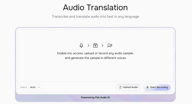
Platforms like Fish Audio specialize in high-quality AI voice synthesis, allowing translated speech to sound smooth and professional. Fish Audio now has its very own audio translation tool known as Fish Audio translate.
Types of AI Audio Translation
Not all translation tools work the same way. There are several common use cases for AI speech translation.
1. Real-Time Speech Translation
Real-time translation is used for live conversations.
Examples include:
-
Video meetings
-
Customer support calls
-
Live presentations
-
International conferences
The system must translate speech instantly with minimal delay.
2. Recorded Audio Translation
Recorded translation works with pre-existing audio files.
-
Examples include:
-
Podcasts
-
Interviews
-
Audiobooks
-
Online courses
-
YouTube videos
These systems often produce higher-quality results because they have more time to process the audio.
3. AI Voice Translation for Content Localization
Content creators often use AI voice translation online tools to localize content for global audiences. Instead of recording multiple language versions manually, AI tools generate translated voices automatically. Solutions like Fish Audio can recreate natural voices in multiple languages, making it easier to distribute content worldwide.
Benefits of AI Audio Translation
AI translation technology offers several advantages for businesses and individuals.
Faster Communication
AI systems translate speech in seconds, eliminating long translation workflows.
Global Reach
Content can be distributed to international audiences without language barriers.
Lower Costs
Hiring translators or voice actors for every language can be expensive. Many tools now offer free AI audio translation options that allow users to test the technology before upgrading.
Scalable Localization
Companies can translate large libraries of content quickly using automation.
Best Use Cases for AI Voice Translation
AI audio translation is now used across many industries.
-
Content Creation
-
YouTubers and podcasters translate content for global audiences.
-
Business Meetings
-
International teams communicate without language barriers.
-
Education
-
Online courses can be translated into multiple languages.
-
Media & Entertainment
-
Films, documentaries, and podcasts can be localized faster than traditional dubbing.
Features to Look for in AI Voice Translation Tools
If you're choosing an AI voice translation online platform, consider these features. Language Support
The best tools support dozens of languages and dialects.
-
Voice Quality
-
High-quality voice synthesis makes translations sound natural.
-
Accuracy
-
Advanced models reduce errors in translation.
-
Voice Cloning
-
Some platforms replicate the original speaker’s voice across languages.
-
Real-Time Processing
-
Important for meetings and live events.
Solutions such as Fish Audio combine advanced speech recognition with neural voice synthesis to produce natural multilingual audio.
Free AI Audio Translation Tools
Many platforms now provide free AI audio translation plans or trials.
These options allow users to:
-
Test voice translation features
-
Translate short audio clips
-
Evaluate voice quality
-
Compare translation accuracy
Free tools are ideal for creators, students, and small teams exploring AI speech translation.
The Future of AI Speech Translation
AI audio translation technology is evolving quickly.
Future developments may include:
-
Real-time multilingual conversations
-
Emotion-aware speech synthesis
-
Personalized AI voice translation
-
Instant video dubbing
-
Cross-language virtual assistants
As models become more advanced, speech to speech translation will become even more seamless and human-like.
Final Thoughts
AI translation technology is transforming how people communicate across languages. With modern AI speech translation systems, users can now convert spoken language into another language instantly using powerful speech to speech translation pipelines.
Tools offering AI voice translation online are making this technology accessible to creators, businesses, and educators worldwide. Many platforms even provide free AI audio translation options so users can experiment before adopting the technology at scale.
Platforms like Fish Audio are helping push the industry forward by combining advanced speech recognition, translation models, and realistic voice synthesis. As AI continues to improve, AI audio translation will play a key role in breaking down global language barriers and enabling universal communication.

Kyle is a Founding Engineer at Fish Audio and UC Berkeley Computer Scientist and Physicist. He builds scalable voice systems and grew Fish into the #1 global AI text-to-speech platform. Outside of startups, he has climbed 1345 trees so far around the Bay Area. Find his irresistibly clouty thoughts on X at @kile_sway.
اقرأ المزيد من Kyle Cui